


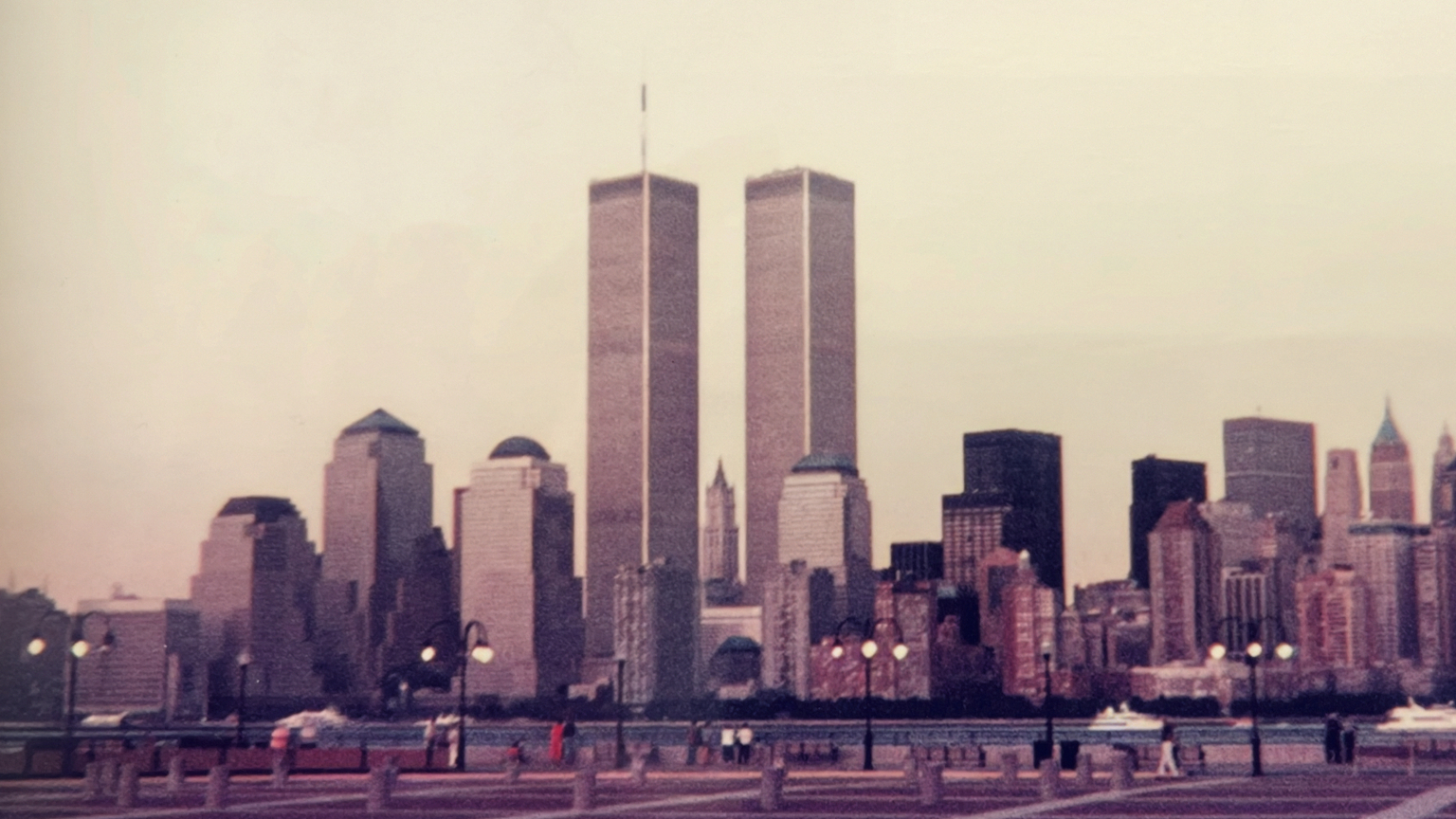
Three days before the September 11 attacks, Tom Dobbins Jr. was attending the annual Catholic Charities USA conference in Newark, New Jersey, when he captured what would become one of the last photographs of the Twin Towers before they fell.
Dobbins, then Catholic Charities of New York’s Criminal Justice Outreach Coordinator, had returned to Liberty State Park with a colleague to retrieve a sweater from his Jeep. As they looked toward the World Trade Center, the setting sun cast the towers in a striking orange glow.
His colleague encouraged him to take a photograph. Dobbins initially wanted to save the film for a planned boat ride, but he agreed.
That simple decision preserved a moment that would soon become part of history.
“It was this magnificent, almost orange hue,” Dobbins recalls. What was an ordinary evening became a moment preserved in time—one that would soon take on a meaning no one could have imagined.
Dobbins’s photograph captured a moment that would soon become impossible to recreate—the Twin Towers standing against the New York sky. In the aftermath of 9/11, the city’s skyline, and the city itself, would be changed forever.
Monsignor Kevin Sullivan, then Executive Director of Catholic Charities of New York, later had the photograph framed and reproduced as a Christmas and thank you gift for Catholic Charities colleagues around the country who’s generous outpouring of support meant so much. The image allows us to remember not only what was lost, but also how quickly our world can change and how important it is to cherish, protect and care for one another.
Memories of a Day That Changed Everything
Dobbins remembers the morning of September 11 vividly. While commuting into Manhattan on Metro-North, he heard an announcement that a plane had struck the World Trade Center. At first, he assumed it was a small aircraft.
When the train reached 125th Street, he looked downtown and saw both towers burning.
At the Catholic Center, staff watched the smoke rising over Manhattan. When they left the building to pray in the chapel below, Dobbins saw hundreds of people walking uptown, covered in dust and trying to make their way to safety.
“Women had taken their high heels off,” he remembers. “It’s something that I will never forget as long as I live.”
The days that followed brought fear, grief and uncertainty. Dobbins had previously worked in Tower 2 and knew people who lost family members and friends. He attended several funerals.
“It was a very difficult time,” he says. “But I think the thing that sticks with me is how Catholic Charities mobilized.”
A Community United in Service
In the aftermath of 9/11, the New York interfaith communities and human service organizations came together to help everyone affected—for the days, weeks, months and even years that followed.
In December 2001, Catholic Charities of New York joined a coalition of nonprofit organizations to form the 9/11 United Services Group (USG). Under Monsignor Sullivan’s leadership, this coalition helped people facing the city’s human and economic devastation with financial hardship, including those who had jobs disappear overnight as a result of the attacks.
The response was fueled by an extraordinary outpouring of generosity from across the country and around the world. Donations arrived alongside letters, drawings from children and messages of support.
The experience also helped shape new approaches to disaster assistance. The group’s work to coordinate services and track the needs of survivors helped lay the groundwork for what became the Disaster Case Management system used by FEMA and other government agencies. The experience helped shape new approaches to disaster assistance.
For Dobbins, the most important lesson was the ability to respond quickly and compassionately.
“We began to figure out how we could help those people most impacted in concrete ways,” he says. “How to mobilize quickly, and how to cut through red tape in order to get effective aid to people when they need it.”
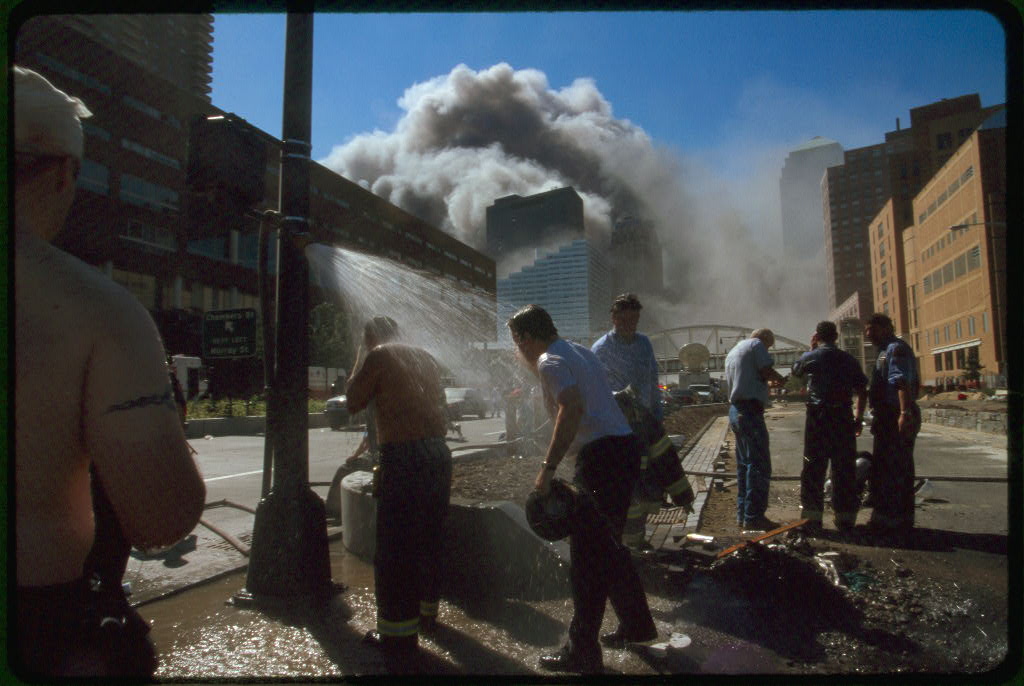
Carrying the Lessons Forward
The relationships formed in the aftermath of 9/11 continued to shape Catholic Charities of New York’s work in the years that followed. The organization learned the importance of bringing people and communities together, particularly during times of crisis.
For Dobbins, the photograph he took before 9/11 and the humanitarian response that followed tell two sides of the same story: a moment of beauty before tragedy, followed by an extraordinary demonstration of compassion.
The September 11 attacks changed New York and the nation forever. The Twin Towers may have fallen, but the compassion that emerged in their absence remains. Catholic Charities of New York, interfaith communities and human service organizations stood together to support those who were grieving, displaced, injured, unemployed or simply trying to make sense of an unimaginable day. That spirit of service is one of the most enduring lessons of 9/11: even in the face of devastating loss, people can choose compassion over fear, generosity over division, and service over silence. The skyline may have changed forever, but so too did our understanding of what it means to stand together when a community needs us most.