






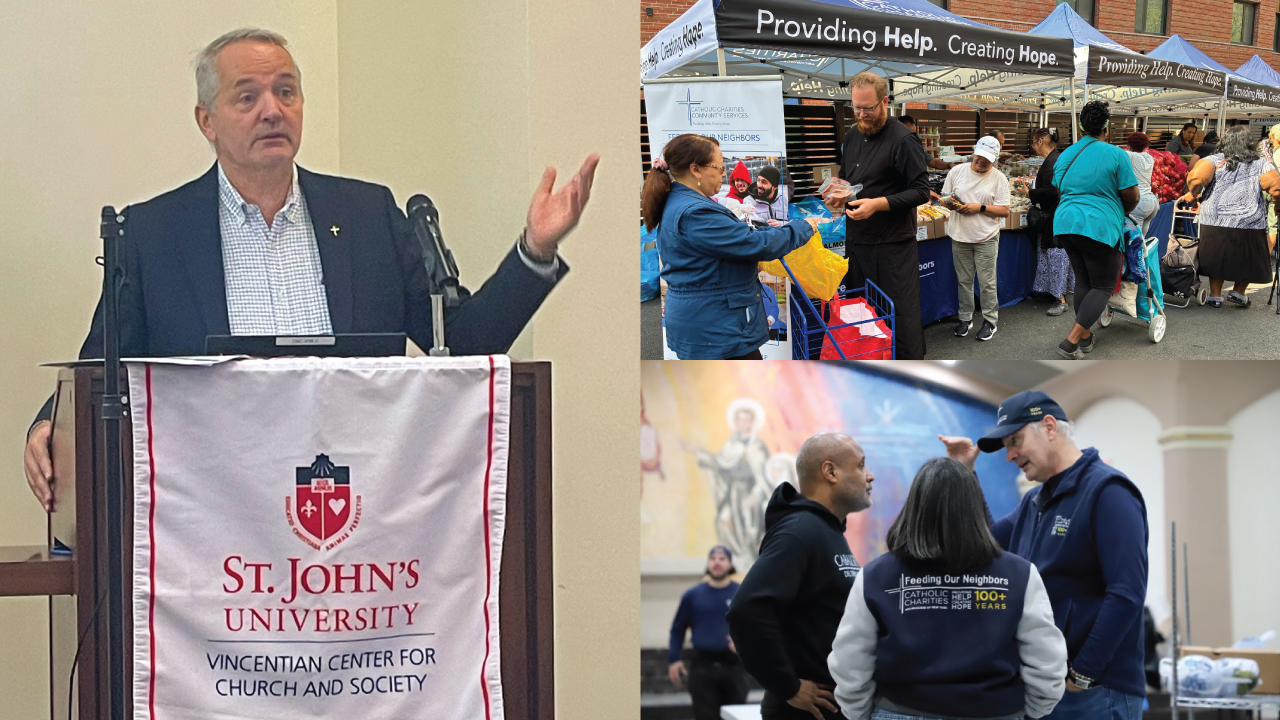
Responding to poverty begins with recognizing the dignity of each person and understanding the circumstances shaping their lives. That principle was at the heart of the keynote presentation delivered by J. Antonio Fernández, CEO of Catholic Charities of New York, for St. John’s University’s Biennial Poverty Conference on Saturday, October 17.
The conference, themed “Catholic Responses to Poverty in the USA,” brought the work of Catholic charitable organizations into focus. Fernández served as the keynote speaker, with a presentation titled “Doing Good and Doing It Well: Catholic Responses to Poverty in a City That Never Sleeps.”
His keynote emphasized understanding the whole person, staying connected to communities, and providing compassionate, high-quality service as needs change.
Understanding the Whole Person
Poverty takes different forms in different communities. Drawing on his experiences leading Catholic Charities in Chicago, San Antonio, and now New York, Fernández examined how local conditions shape both the challenges people face and the help they can access.
Housing affordability and stability, transportation, and the strength of community connections all influence a person’s circumstances. Urban, suburban, and rural communities require approaches suited to their realities. Local government, schools, parishes, and service agencies each have a role in responding.
For Catholic Charities of New York, that means understanding how needs connect. Effective service is seeing the whole person and looking beyond the immediate request.
Responding as Needs Emerge
Responding to changing needs requires being close enough to understand them. Fernández’s leadership in San Antonio and New York offers two examples of how that commitment takes shape.
Catholic Charities of San Antonio provided shelter and assistance to migrants arriving in the city amid a surge in migration through this major transit hub, with at least 250,000 migrants passing through San Antonio starting in January 2023.
Fernández spent nights on a cot alongside asylum seekers at the organization’s migrant resource center, listening to their stories. “If I don’t spend time with them, it’s going to be very hard for me to understand” their experience, Fernández said in 2023.
That same commitment to presence guided Fernández’s response to the April 2026 fire in the Bronx, which claimed two lives, injured more than a dozen people, and displaced more than 80 residents across 24 families. He went to the site while first responders were still on the scene, speaking directly with families and coordinating Catholic Charities of New York’s response.
Working with Our Lady of Mt. Carmel Church parish, Catholic Charities of New York mobilized emergency assistance, distributed essential supplies, and provided legal support and grief counseling. As families’ needs evolved, teams helped them recover documents, navigate housing applications, and find permanent homes, while advocating for extensions of temporary hotel stays.
These responses in San Antonio and New York reflect a long tradition of Catholic organizations serving within the communities they call home.
A Catholic Tradition of Welcome and Service
Fernández’s keynote placed today’s response to poverty within the longer history of Catholic contributions to American life.
Beyond social service agencies and parishes, Catholic hospitals, health care systems, schools, and universities have helped shape the fabric of America. Institutions, like St. John’s University, carry that legacy forward through education and a commitment to serving their neighbors.
The broader conference program reflected the range of Catholic efforts to address poverty.
Organized by St. John’s University Vincentian Center for Church and Society, led by Rev. Patrick J. Griffin, C.M., Executive Director, the conference explored the history and continuing mission of Catholic service. It included “Mission of Charity: History and Future,” presented by Rev. Msgr. Alfred P. LoPinto, Emeritus Chief Executive Officer of Catholic Charities Brooklyn and Queens.
Fernández’s closing offered words from St. Vincent de Paul: “Charity is the cement that binds communities to God and persons to one another.”
That legacy endures as Catholic institutions commit to doing good and doing it well, recognizing that a society’s greatness rests in how it cares for those who have the least.