



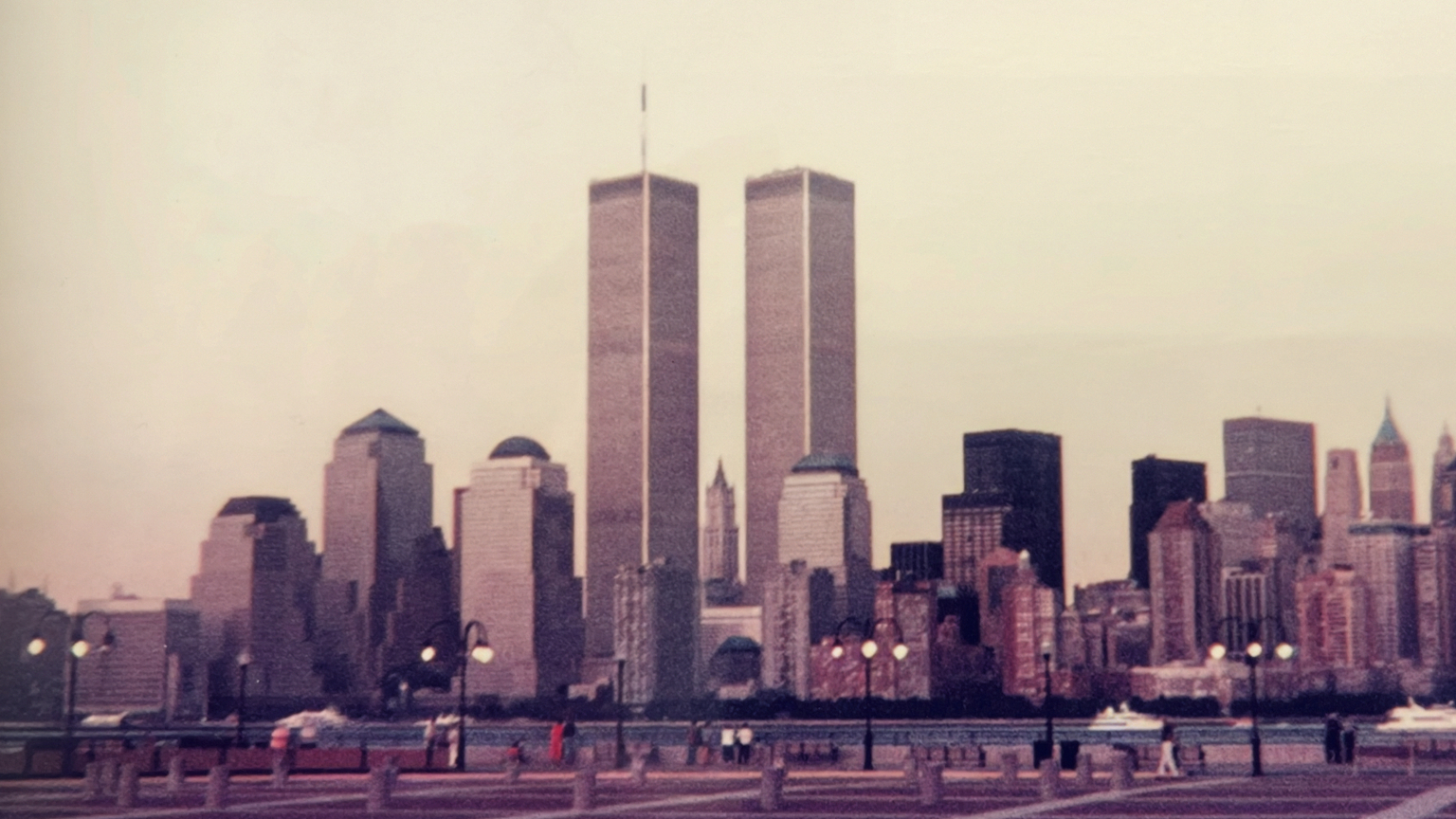
Three days the September 11 Attacks, Tom Dobbins Jr. was serving as Catholic Charities of New York’s Criminal Justice Outreach Coordinator. While attending the annual Catholic Charities USA conference in Newark, New Jersey, he ended up snapping what would be one of the last photographs ever taken of the Twin Towers from Liberty State Park.
That evening, he was heading to a scheduled boat ride around Ellis Island as part of the conference: “My colleague at the time, Alison Hughes-Kelsic, had left her sweater in my Jeep. She said we had to go back to get it. We both did, and when we were coming around the corner again, we looked up at the World Trade Center. The sun was going down and the color was this magnificent, almost orange hue.”
“Alison said, ‘My God, that’s beautiful. You should take a photograph of it,’ because I had an Instamatic camera at the time. And I said, ‘No, I want to save the photos for the boat,’ but she replies, ‘No, really, this is beautiful. You should take it.’ So, I did.”
It would be one of the last ever sunsets to fall on Towers 1 and 2. Dobbins’s decision to capture that moment gave his community a way to share in its warmth long after the buildings collapsed.
“Monsignor Kevin Sullivan, who was executive director of Catholic Charities at that time, got it framed,” recalls Dobbins. “He loved the photo so much, he wanted to do something with the photo as a Christmas gift for the other Catholic Charities folks that from around the country were so generous to us. So, I gave him the negative, and he made copies of that photo, and then that photo was shared with Catholic Charities agencies.”
Indelible Memories from a Tragic Event
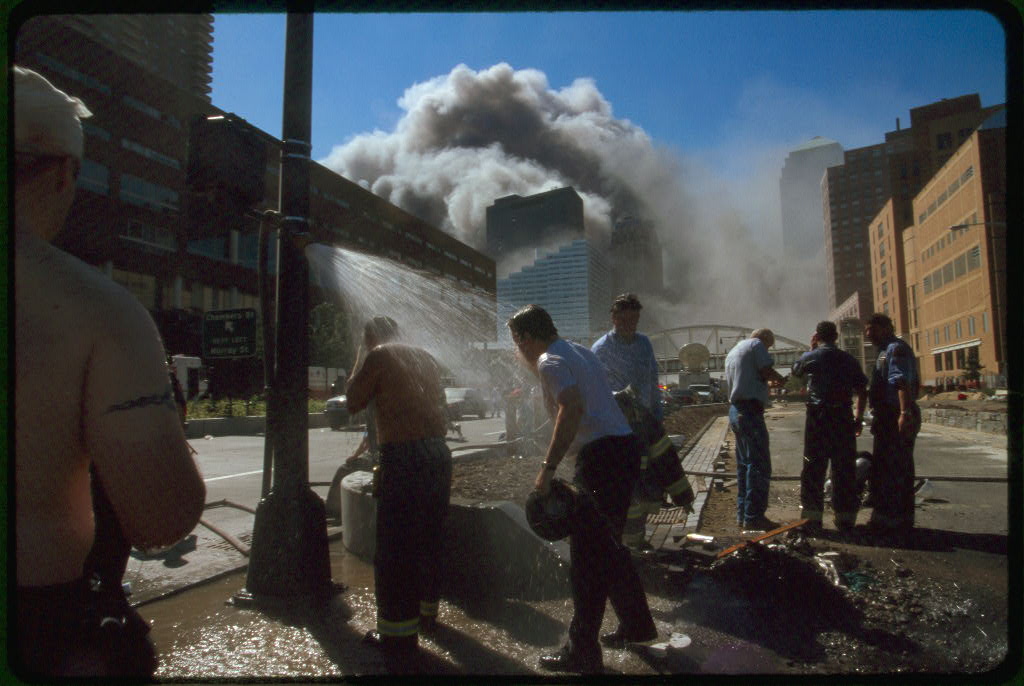
Dobbins, now the Deputy Director for the Department of Public and Community Engagement for Catholic Charities of New York, remembers vividly the chaos that unfolded in Manhattan days later: “I remember pulling into the train station at 125th Street in Harlem, and the conductor came onto the intercom saying, ‘If you work downtown, you should contact your place of employment because a plane has struck the World Trade Center.’”
“I thought, ‘Oh, it must have been like a Cessna or a Piper Cub or one of these smaller planes.’ But when we pulled into the station and I looked downtown, I could see that both towers were on fire.”
Later that day, Catholic Charities of New York staff left their offices to pray in the chapel below, which required exiting the building. “As we were leaving, people were coming uptown from downtown. They were walking up First Avenue to cross the 59th Street Bridge. They were just covered in the dust, hundreds of people that were walking up. Women had taken their high heels off. It’s something that I will never forget as long as I live.”
The Relief Effort: Strength in the Face of Trauma
Prior to joining up with Catholic Charities of New York, Dobbins worked for the New York State Commission on Government Integrity, a predecessor of the present-day Commission on Ethics and Lobbying in Government.
His office was in Tower 2.
“There were colleagues of mine who lost family members, friends of mine who lost family members. I remember going to several funerals,” he explains.
“It was a very difficult time,” he adds, “but I think the thing that sticks with me is how Catholic Charities mobilized.”
In December 2001, a coalition of 13 nonprofit organizations formed the 9/11 United Services Group, per the recommendations of the September 11th Fund. Monsignor Sullivan was made the chair of the coalition, which distributed aid to those who experienced financial hardship, including job loss, due to the attacks.
The database they created would become the basis of what is now known as the Disaster Case Management system, used by FEMA and other government agencies.
“There was an outpouring of generosity that kept coming in,” remembers Dobbins. “We would receive little drawings sometimes from grammar school children from other parts of the country.”
“I think that that’s one thing particularly the Catholic Charities did and did well, figuring out how to mobilize quickly, and how to cut through red tape in order to get effective aid to people when we need it.”
Carrying the Lessons Forward
The lessons learned and relationships forged in the aftermath of 9/11 were useful when new crises required charitable intervention. As Dobbins explains, Catholic Charities of New York came to understand that it had a special role in bringing together people of faith.
“We became conveners of folks across cultural divides to feed the hungry in the Bronx, Harlem, and Staten Island” says Dobbins. “We began to see how we could with these communities in constructive ways that were respectful of the human dignity.”
Dobbins acknowledges that the time after 9/11 was polarizing, and in many respects, rife with fear and uncertainty. He notes that not all societal shifts were for the better. But he believes there is a lesson for future generations.
“The world is just too important to leave to bad actors,” he says. “A few bad actors can do terrible, terrible damage. But the rest of us have to come together, to say no to the bad actions, and to say a positive yes to helping others, to being generous, to reaching out, to doing the right thing.”